
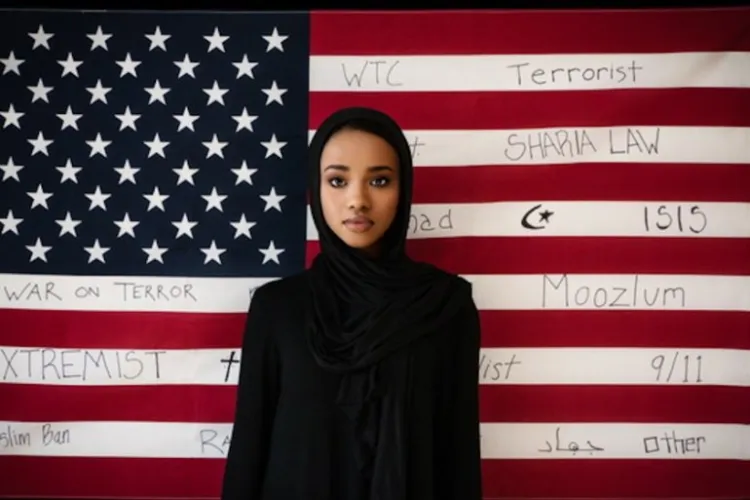
Last year on 9/11, my then 5th grade daughter returned home from school visibly distressed. I became worried. “What happened?”- I asked. She urged me to sit down and watch a video with her. Her social studies teacher had shown the class a short segment documenting the horrific attacks on the World Trade Center, now twenty-five years ago. She was shocked to learn that people who had self-identified as Muslims had committed this tragedy.
The painful expression on her face haunts me to this day. As I am writing these lines, tears are flowing. At that moment, her world broke down. As long as she had lived, Islam had meant love, beauty and goodness for her. It meant to care for our neighbors by inviting them over for bonfires in our yard and to share meals together. It meant charitable work by organizing Ramadan food drives with the aunties and uncles in the community while having fun with her friends. Islam was encouraging her to study hard in school and become a constructive citizen who makes this world a better place for all. Most importantly, Islam continued to be a source of meaning and consolation in the midst of intense grief and sorrow. After her little sister Meryem had died in a tragic car accident leaving her an only child, Islam had given her strength and hope. How can anyone commit atrocities in the name of Islam?!
For her and the nearly two billion Muslims of the world, the teaching of the Qur’an and the spiritual legacy of Prophet Muhammad was life-affirming. My daughter was surrounded by an amazing diverse Muslim community who embodied these ideals for her. So much so, that she decided to proudly express her Muslim identity and start wearing the hijab – the headscarf – early on in fourth grade. As parents, we strongly objected that choice because of her young age. At her public school, she was the only Muslim girl visible with her hijab. While I admired her confidence and courage, as a mother and educator I was extremely concerned. I wanted to shelter her from the cruel phenomenon of Islamophobia. That day on 9/11, I realized I had failed terribly both as a parent and as a public educator. I felt guilty and remorseful that I had not prepared her better for this reality.
After some painful silence, I asked my daughter how she felt after learning about 9/11. And then in an almost uncanny adult way and with words that she had never used before in her life, she responded: “I feel betrayed.” I was stunned. I could not say anything. I only kept quiet. Then she got up and left the room.
For some reason, I had been in denial that the tragedy of 9/11—even twenty-five years later—would have the same negative psychological impact that it had on my generation. I was wrong and naive. As a Muslim student who had experienced persistent Islamophobia in the classroom, I knew how to feel guilty by religious association. I knew the feelings of shame and anger. I also knew the feeling of betrayal. I had worked hard every day to prove to the outside world that I was a “good Muslim.” In an instant, terrorists had destroyed my efforts forcing an image upon me that felt deeply unjust and did not reflect who I truly was. This is exactly how my daughter had felt in the classroom. It took me years to unlearn that I cannot be held responsible for the outrageous acts of adults. As Muslim scholar Bediüzzaman Said Nursi reiterates the Qur’anic call for justice, “No soul shall bear the burden of another soul,” (Qur’an 35:18).
As a mother and educator, I had introduced my daughter to the most beautiful aspects of Islam. The truth however is that communities can be both beautiful and broken. Communities are also a reflection of the fullness of the human condition and its contradictions: The best and the worst, the successes and failures, the simple and messy—all are present. For various reasons though, Muslims are always being portrayed as more vile and dangerous. The teacher chose deliberately to leave out the vast beautiful experience of Muslims and how their faith empowers them to do good in the world. He chose to give preference to a devastating example of the worst of human impulses: hate, hostility and destruction. In the minds of these young students, Islam manifested now as a dangerous ideology to be feared. Muslims are not to be trusted. The cycle of Islamophobia continued.
For five years, Islam and Muslims did not show up in my daughter’s school curriculum. It is important to add that we live in one of the most diverse regions of the United States. Five million Muslims in America are simply unaccounted for in the educational teaching plan. Muslims remain largely invisible in textbooks. For five years, her classmates had not heard a single word about the history of Muslims in America, their important contributions to science and human civilization, their co-existence with various communities around the world or any personal Muslim stories and experiences. Including these and many other helpful resources in the classroom would have ensured that students learned of the diversity, complexity and nuance of the Muslim community.
As Jason Creeger, Program Manager for Teachers and Schools at the Institute for Islamic, Christian and Jewish Studies in Baltimore observes, “What does it mean when students encounter Islam in curriculum—but only through the lens of conflict or war? What are students missing when they don’t learn about Muslim values or the rich history of interreligious dialogue among Jews, Christians, and Muslims? The concept that there are most likely blind spots in our curriculum, or at least missed opportunities, is something that all educators need to reflect more on.”
Psychologist Gordon Allport’s contact hypothesis states that interpersonal interaction between different social groups can effectively reduce prejudice, but only when specific supportive conditions are present. The classroom can foster such belonging.
As a mother and scholar on interreligious education, I see teachers as my allies and partners in raising the next generation of civic leaders and public servants. Our students should be educated about and exposed to the complexity and beauty of different religions, their rich cultures and their diverse communities. This could help us raise a generation of global citizens who accept and embrace difference—and could advance a flourishing citizenry.
This piece was published in The Baltimore Sun
The German version was published on IslamiQ and Islamische Zeitung
Zeyneb Sayılgan, Ph.D., serves as the Muslim Scholar at the Institute for Islamic, Christian and Jewish Studies in Baltimore. Her research focuses on Islamic theology, spirituality and ethics as articulated in the writings of Muslim scholar Bediüzzaman Said Nursi (1876-1960). Her other areas of interest are Christian-Muslim relations and the intersection of religion and migration. She holds a doctorate in Theological and Religious Studies from Georgetown University, a Master degree from Hartford International University for Religion&Peace in Islamic Studies and Christian-Muslim Relations and a Master degree in Islamic Studies and Public Law from the Johannes Gutenberg University in Mainz, Germany. From 2010-2014, she served as a Muslim Chaplain-in-Residence on Georgetown’s campus supporting students from (non-) and all religious backgrounds. Zeyneb’s personal experience of growing up in Germany as the daughter of Muslim immigrants from Türkiye informs her academic work and community engagement. She has written for The Washington Post, The Guardian, The Baltimore Sun, Religion News Service and many other outlets. All her work is accessible on her blog. Zeyneb is the host of the Podcast On Being Muslim: Wisdom from the Risale-i Nur which is also available in German Begegnung mit dem Islam.



 teachings on maternal care and his own expression of love towards his mother even after her death offer me comfort in times of distress. A few of them are particularly close to my heart:


